


Stent Retriever Thrombectomy in Patients With Myocardial Infarction: The Open-Label, Multicenter NATURE Superiority Trial
Marco Valgimigli, Enrico Frigoli, Antonio Landi, Marco Covani, Simone Biscaglia, Florim Cuculi, Andrea Erriquez, Matthias Bossard, Antonio Mangieri, Martijn Meuwissen, Juan F. Iglesias, Giuseppe Sangiorgi, Erik Lipšic, Jacopo Andrea Oreglia, Jonas D. Häner, Valeria Paradies, Anna Giulia Pavon, Laura Anna Leo, Felice Gragnano, Federico Fuentes, Vincenzo Viccaro, Antonio Colombo, Sanda Branca, Sergio Leonardi, and Hector M. Garcia-Garcia for the NATURE Investigators
Journal of American College of Cardiology – 2026
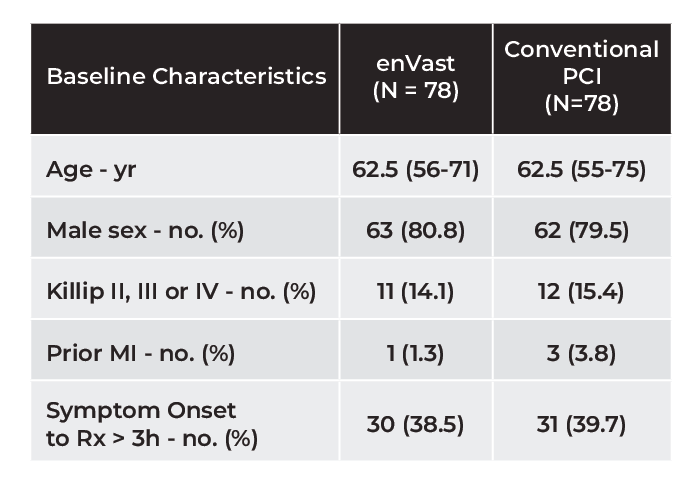
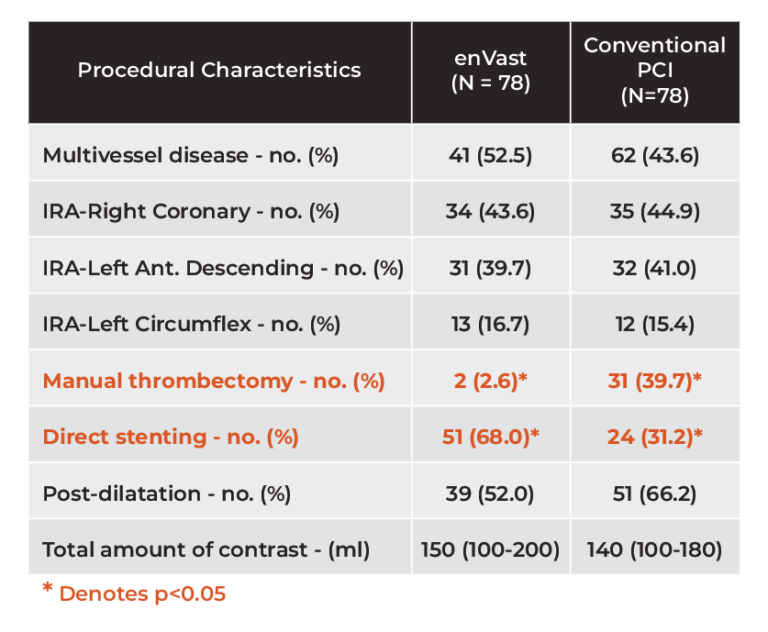
The purpose of this study was to investigate the effects of stent-retriever thrombectomy in addition to conventional percutaneous coronary intervention (PCI) vs conventional PCI alone on infarct size.
We analysed consecutive patients from the prospective OPTIMISER registry (NCT04988672), who have been managed with the NeVa™ MTD (Vesalio, USA) for AMI with LTB at a tertiary cardiology facility. Outcomes of interest included, among others, periprocedural complications, target lesion failure (TLF), target lesion revascularization (TLR) and target vessel myocardial infarction (TV-MI).
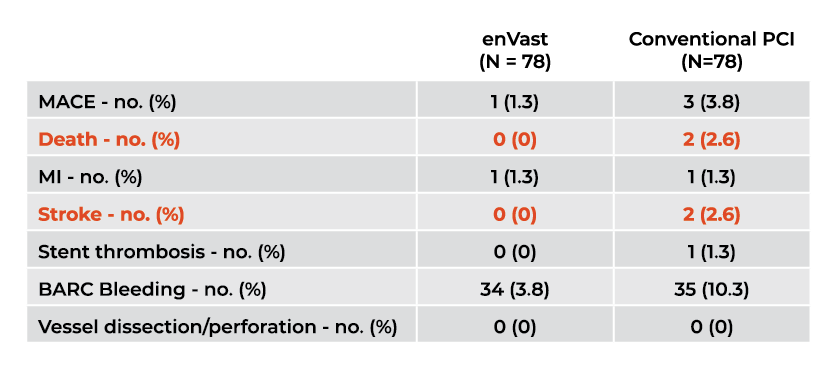
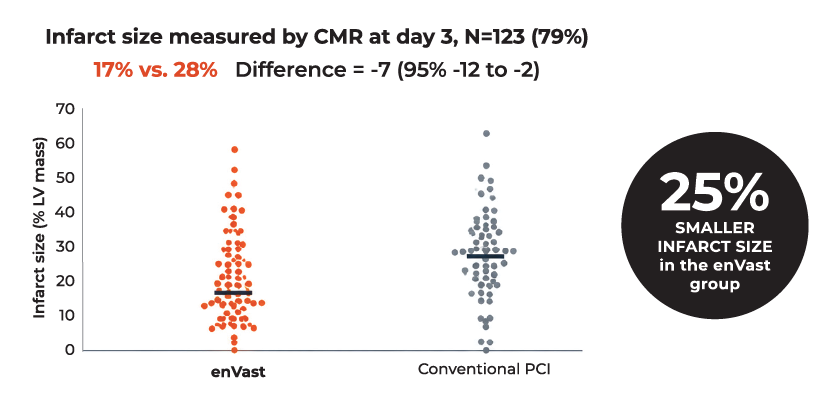
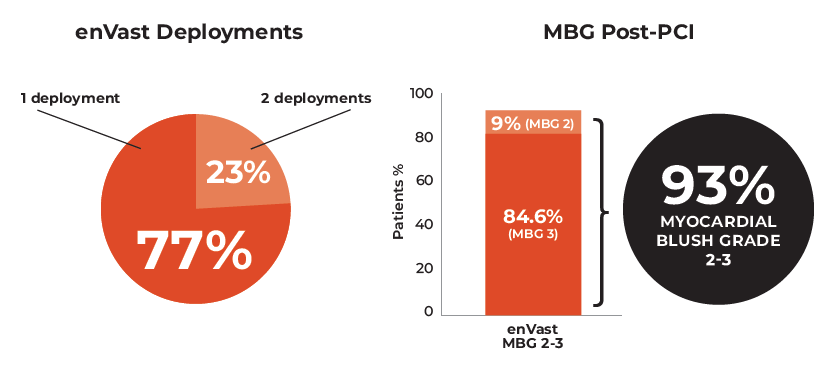
Infarct size (creatine kinase-MB area under the curve) was lower in the stent-retriever group (n = 78) vs the conventional group (n = 76) (3,965 IU/L·h; Q1-Q3: 2,480-5,092 IU/L·h vs 5,250 IU/L·h; Q1-Q3: 3,506-7,449 IU/L·h; difference −1,359; 95% CI: −2,231 to −522; P = 0.001). At exploratory cardiac magnetic resonance findings, infarct size was lower in the stent-retriever group (n = 64; left ventricle, 17%; Q1-Q3: 11%-28%) vs the conventional PCI group (n = 59; 28.0%; Q1-Q3: 18%-33%; difference −7.0; 95% CI: −12 to −2.0), whereas left ventricular volumes and ejection fraction did not differ. There were no major adverse cardiovascular events at 3 days and 1 at 30 days in the stent-retriever group vs 2 and 3 major adverse cardiovascular events, respectively, in the conventional PCI group.
In STEMI patients with large thrombus burden undergoing primary PCI within 8 hours of symptom onset, enVast assisted mechanical thrombectomy, compared with conventional PCI, was associated with reduced infarct size.
| Cookie | Duration | Description |
|---|---|---|
| cookielawinfo-checkbox-analytics | 11 months | This cookie is set by GDPR Cookie Consent plugin. The cookie is used to store the user consent for the cookies in the category "Analytics". |
| cookielawinfo-checkbox-functional | 11 months | The cookie is set by GDPR cookie consent to record the user consent for the cookies in the category "Functional". |
| cookielawinfo-checkbox-necessary | 11 months | This cookie is set by GDPR Cookie Consent plugin. The cookies is used to store the user consent for the cookies in the category "Necessary". |
| cookielawinfo-checkbox-others | 11 months | This cookie is set by GDPR Cookie Consent plugin. The cookie is used to store the user consent for the cookies in the category "Other. |
| cookielawinfo-checkbox-performance | 11 months | This cookie is set by GDPR Cookie Consent plugin. The cookie is used to store the user consent for the cookies in the category "Performance". |
| viewed_cookie_policy | 11 months | The cookie is set by the GDPR Cookie Consent plugin and is used to store whether or not user has consented to the use of cookies. It does not store any personal data. |

by removing vascular occlusions and restoring blood flow
Please select your region to enter our world of innovation:
"*" indicates required fields